Toledoth of Terah (Abraham's Story)
Gen. 11:27–25:11
CHIASTIC STRUCTURES OF THE TOLEDOTH OF TERAH
A Introduction of Abram and Sarai (11:27–11:32)
B CENTRAL THEME: ABRAHAM AND SARAH (12:1–21:7)
A’ End of Abraham and Sarah’s Life (21:8–25:11)
TIMELINE OF ABRAHAM AND SARAH

THE TOLEDOTH OF TERAH
A - Introduction of Abram and Sarai (11:27–11:32)
a Introduction of Terah (11:27)
(27) Terah begot Abram, Nahor, and Haran. Terah was 70 years old when he began to have children. However, if he died at age 205 when his son Abram was 75 years old, then he was 130 years old when Abram was born.
205 – 75 = 130
Haran begot his son Lot, and his daughters Milcah and Iscah.
b The family lives in Ur of the Chaldees (11:28)
(28) However, Haran died in Ur of the Chaldees, which is located in Southern Mesopotamia. However, the tablets of Ugarit, Nuzi, and Ebla refer to Ur in Southeastern Turkey.
c CENTRAL THEME: Abram takes Haran's daughter (11:29-30)
(29) Abram marries Sarai and Nahor marries his niece Milcah.
According to Josephus (Antiquities of the Jews: Book 1:6:5; Book 1:7:1), Haran has two daughters, Milcah and Sarai (Iscah). So, did Abram marry his niece? In this culture, the marriage would have been considered very acceptable.
(30) Sarai is barren.
b' The family leaves Ur of the Chaldees (11:31b)
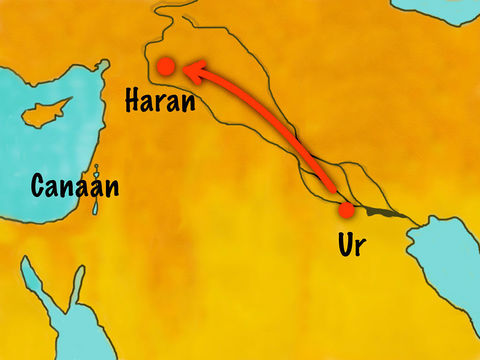
(31) Terah leaves Ur of the Chaldees with his son Abram and his daughter-in-law Sarai, and his grandson Lot. They intend to go into the land of Canaan, but coming to Haran, they settle there.
Why did Terah leave Ur of the Chaldees with his family? According to Joshua 24:2, both Terah and Abram served other gods on the other side of the river, which would be the Euphrates River. Josephus says that Abram converted to YHWH, and historically offended the local Nimrod and residents with his beliefs. So, the family left Ur (city) and settled in Haran, and then Terah built the Temple of Sin (a moon goddess). Poor Abram! He was detained from going to Canaan for five years before his father Terah died. Haran later became the important Roman city, Carrhae.
a' Conclusion of Terah (11:32)
(32) Terah was 205 years old when he died in Haran.
B - CENTRAL THEME: ABRAHAM AND SARAH (12:1–21:7)
a Abram's Journey to Canaan and the Promise of Descendants (12:1–12:9)
(1-3) YHWH calls Abram out of his country and promises blessings upon him and upon his descendants.
(4-7) Abram departs to the land of Canaan when he was 75 years old, along with his wife Sarai and his nephew Lot, and his possessions and those living in his household in Haran. YHWH appears to Abram and promises him the land, and Abram builds his first altar to YHWH near Shechem.
Now Abram would have travelled from Haran southward, continuing east of the Jordan River, and crossing over towards Shechem unto the Oak of Moreh. Could this altar be at the same location that Joshua built later? This area was the territory of the Canaani.
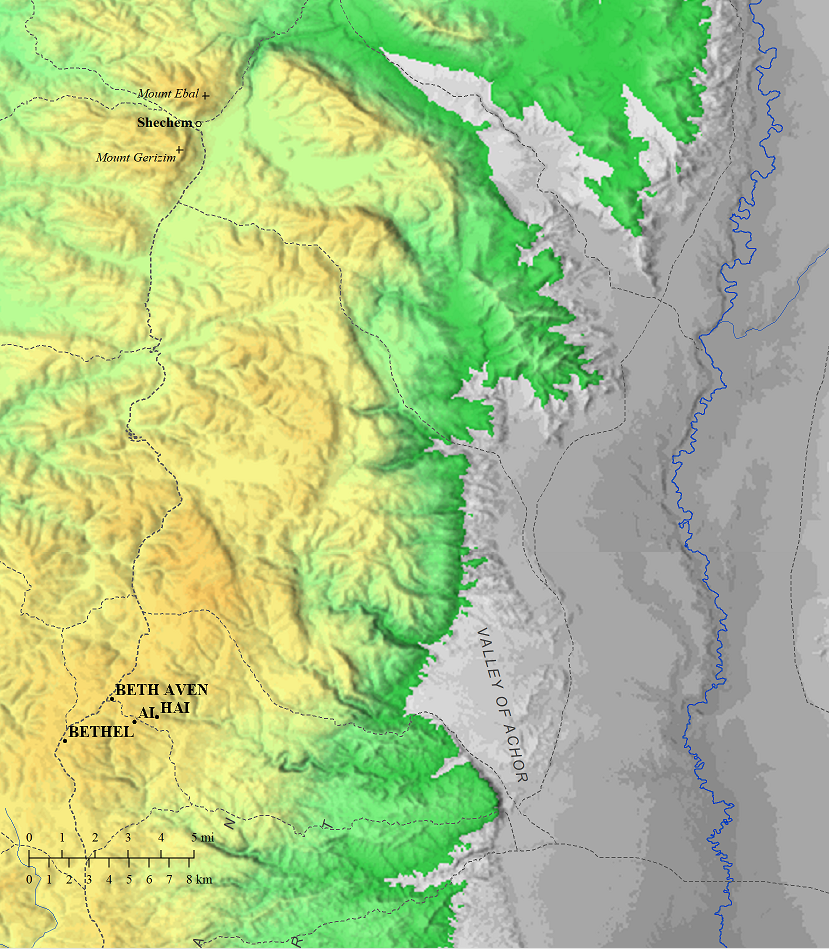
(8-9) From there Abram moves southward to a mountain between Bethel on the west and Hai on the east, and builds his second altar and calls upon YHWH.
The Hai of Abram’s time is in a different location (possibly et-Tell) than the Ai of Joshua’s time (Khirbet el-Maqatir). While the modern translations choose to use Ai for both locations, the KJV uses Hai for the time of Abram, and Ai for the time of Joshua. This distinction will clearify the differences of location and time period.
I’ve actually worked at the archaeological site of Joshua’s Ai (Khirbet el-Maqatir). Abram’s altar would be at the same location of Joshua’s Ai, since it was uninhabited at the time of Abram.
Then Abram journeys to the Negev (South).
b Abram lies about Sarai (12:10–21:20)
(12:10-13) On account of a famine, Abram sojourns in Egypt. However, his wife Sarai is beautiful and Abram is afraid that he would be killed on account of her. So, he asks her to say that she is his sister. Was Sarai Abram’s sister? Not literally, but the term sister here could mean a close kinswoman.
Sarai’s real name was Iscah (to watch, observe). According to Josephus, she was his niece, a sibling to Lot and Milcah. Abram called her Sarai (princess), an honor referring to a paternal cousin. Though she wasn’t his cousin, she was his paternal niece.
(12:14-20) As expected, Sarai is noted for her beauty and is taken into Pharaoh’s house. Abram receives many gifts from Pharaoh. When YHWH plagued Pharaoh and his house, Pharaoh asks Abram why he had done such a deed which might have led to Pharaoh taking Sarai as his wife. He then sends Abram and Sarai away with all that Abram has. Who was this Pharaoh? Mentuhotep II of the 11th dynasty.
Mentuhotep II

c Lot settles in Sodom (13:1–13:18)
(13:1-7) Abram and Sarai, along with Lot, leaves Egypt into the Negev (southern Israel). Abram’s excursion into Egypt has left him rich. He continues northward to the place of his second altar, between Bethel and Hai, and calls on the name of YHWH. However, Abram and Lot had so many flocks, and herds, and tents which causes strife between them. Besides the Canaani and Perizzi were already there.
(13:8-13) Abram decides it is best for him and his nephew to separate for lack of space. Lot chooses the lush plain of Jordan, where the cities of Sodom and Gomorrah are located, and Abram remains in the land of Canaan. The men of Sodom are wicked sinners.
(13:14-18) YHWH promises Abram and his descendants the land, and for Abram to walk through it. Abram dwells among the oaks of Mamre, where Hebron is located, and builds a third altar unto YHWH.
Oak of Mamre


d Abram intercedes militarily for Lot (14:1–14:24)
(14:1-9) Four foreign kings make war against the five local kings of the Jordan plain, in the valley of Siddim, where the Salt Sea is located. For twelve years these local kings had served the king of Elam, and then rebelled. In the fourteenth year, the king of Elam and his allies attack. These eastern kings attack different areas besides the Jordan plain, but the main war is waged in the valley of Siddim.
(14:10-13) The valley of Siddim was full of bitumen pits, which is where the kings of Sodom and Gomorrah flee and fall. The other three kings flee to the mountain. The enemy kings take the goods of Sodom and Gomorrah, along with Lot, Abram’s nephew.
(14:14-17, 21-24) When Abram hears that his nephew has been taken captive, he arms 318 of his trained servants and pursue them northward unto Dan, smiting them, even unto Hobah, north of Damascus. Abraham rescues all the goods, Lot and his goods, and the captives.
Hobah was on the left of Damascus as one looks towards the East, not the North.
The king of Sodom offers Abram the goods in return. Abram refuses anything for himself, except for the three Amori who help him: Aner, Eschol, and Mamre.
(14:18-20) Melchizedek king of Salem, priest of the Most High God, brings forth bread and wine. Melchizedek, King of Righteousness, blesses Abram, and Abram give Him tithes.
Who was this King, but Jesus Christ (Hebrews 7:1-10).
Four Kings
It’s possible that Amraphel of Shinar would have been from Sumer or Southeastern Turkey, Ariorch of Ellasar would have been from Larsa in Southern Iraq, Chedorlaomer would have been from Elam in Iran, and Tidal from northern Iraq, Iran, or from the Hittite kingdom in Turkey.
Five Kings
Five local kings: Bera king of Sodom, Birsha king of Gomorrah, Shinab king of Admah, Shemeber king of Zeboiim, and the king of Zoar.
Bitumen

Why were these four foreign kings who came from afar so interested in maintaining control of this area? Sodom and her sister cities were rich from the sale of bitumen (asphalt). Asphalt was a commodity in demand for medicinal use and for the process of Egyptian mummification.
e Promise of a son (15:1–15:21)
(15:1-6) YHWH comes to Abram in a vision, telling him to fear not: I AM your shield and your exceeding great reward. Abram petitions YHWH about his situation of a lack of an heir. YHWH promises him an heir, and his seed would be as the number of stars. Abram believed YHWH, which YHWH counted it to him as for righteousness.
Abraham was an astronomer according to Josephus, and would have known that the number was limitless. The naked eye can see 5000 stars.

(15:7-12) YHWH reminds Abram that He brought Abram out of Ur of the Chaldees to inherit this land. Abram wants to know how he shall inherit the land. YHWH tells Abram specifies certain animals for sacrifice. Abram obeys. At sunset, Abram falls into a deep sleep and a horror of great darkness falls upon him.
Could this be the same darkness that fell upon Jerusalem when Christ was crucified?
(15:13-21) YHWH tells Abram that his seed will be a stranger in a land that is not theirs and serve them for four hundred years. YHWH will judge that nation whom they serve. Abram will live a long life. In the fourth generation, Abram’s descendants will return. At sunset it was dark, and a smoking furnace and a burning lamp passes between the pieces of sacrifices. YHWH covenants with Abram to give this land from the Naḥal Mizraim (Brook of Egypt) to the river Euphrates (in the north): the land of ten different nations including the Canaani.
This event took place sometime Abram returned from Egypt and before the birth of his son Ishmael.
f Ishmael's birth (16:1–16:16)
(16:1-4) After dwelling in the land of Canaan for ten years, Abram listens to his wife Sarai about taking Hagar, her Egyptian maid, and obtaining children through her. After Hagar becomes pregnant, she despises Sarai.
(16:5-6) When Sarai takes the problem to Abram, he gives his approval for Sarai to handle the situation. Sarai is hard on Hagar, who flees.
(16:7-14) The angel of YHWH finds Hagar by a fountain of water in the wilderness, and tells her to return and to submit to Sarai. The angel promises that her seed would be multiplied, and her son shall be called Ishmael meaning “God will hear”: because YHWH has heard your affliction. He will be a wild man. Beerlahairoi means “well of the living Vision”.
(16:15-16) Hagar returns back to Abram and Sarai. Abram is 86 years old at the time of Ishmael’s birth.
Beer La Hai Roi
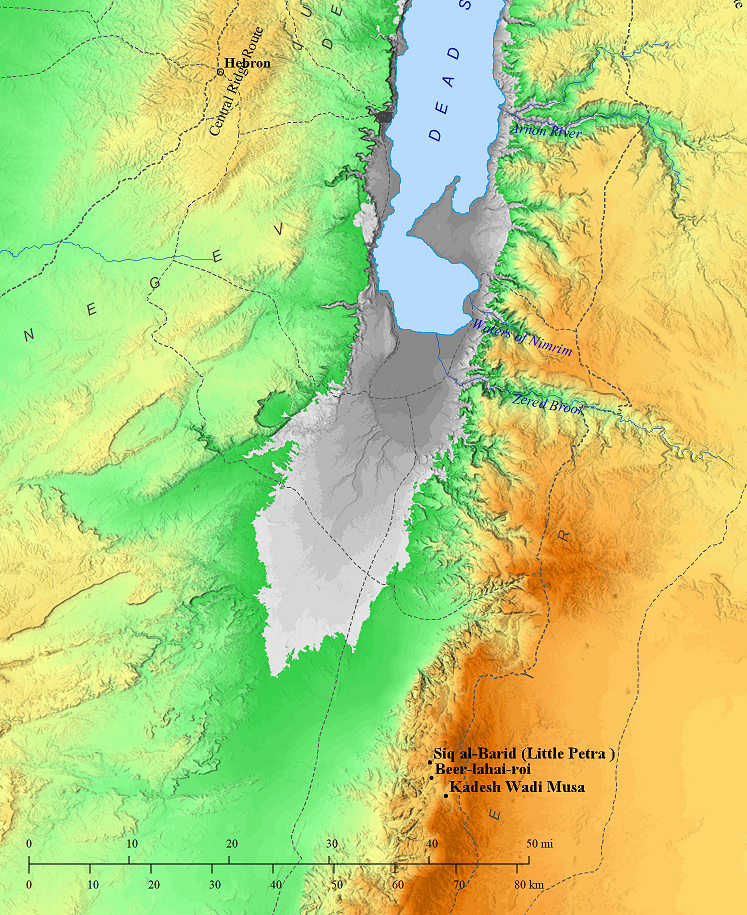
Beerlahairoi is not Beersheba, but was eastward across the Jordan between Kadesh (Petra) and Bered (Little Petra).[1] The road south of Petra eventually leads to Egypt.
[1] https://www.thetorah.com/article/locating-beer-lahai-roi
Ishmaeli
The Ishmaeli dwelt between Havilah (near the Persian Gulf) and Shur (east of Egypt) going northwards towards Assyria (Gen. 25:18). This is the northern part of the Arabian Peninsula. Thus, Ishmael was not a true Arabian, although Josephus refers him as such.
g CENTRAL THEME: YHWH's Covenant with Abram (17:1–17:21)
(17:1-8) When Abram is 99 years old, YHWH appears to him, saying I AM the Almighty God; walk before me, and be perfect. YHWH promises a covenant with Abram, changes his name to Abraham, promising that He has made Abraham a father of many nations, and kings would come forth from him. This would be an everlasting covenant, and the land of Canaan would be given to his seed.
The additional “h” to Abraham’s name represents a breath of the Ruach (spirit) of God.
(17:9-14) God gives the sign of the covenant, which is every man child should be circumcised. On the eighth day after birth, every child born in the household shall be circumcised. Anyone uncircumcised shall be cut off from his people because he has broken God’s covenant.
Circumcision was not as invasive as it had become since 140 A.D. Prior to the first century, circumcision was a minor procedure in which the end of the foreskin extending beyond the tip of the glans was removed, and then healed quickly. This was called a “milah”. Michelangelo’s David presents David as having an infant “milah” circumcision.[1]
[1] http://www.cirp.org/library/history/peron2/
(17:15-21) God changes Sarai’s name to Sarah, and promises to bless her with a son. Abraham falls upon his face and laughs that a child should be born to him at 100 years old and to Sarah who is 90 years old. Abraham’s desire is that Ishmael might live for God!
God confirmed that Sarah shall indeed bear a son and that Abraham should name the child, Isaac. Also, Ishmael would be blessed, be fruitful, and be multiplied into a great nation. However, the covenant would be with Isaac, Sarah’s son, who would bear a son the next year.
The additional “h” to Sarah’s name represents a breath of the spirit of God. Also, Isaac’s name means “laughter”.
f' Ishmael and Abraham circumcised (17:22–17:27)
(17:22-27) Abraham takes Ishmael, and all the males born in his house or bought with money, and circumcises them. Abraham is 99 years old when he is circumcised, and Ishmael is 13 years old.
e' Promise of a son (18:1–18:15)
(18:1-9) YHWH appears unto Abraham among the oaks of Mamre near Hebron in the form of three men. Abraham offers to give them water, bread and veal. Sarah is behind the tent making the cakes.
(18:10-11) One of the men tells Abraham that the time of time of life would return for him, and Sarah would have a son. Both Abraham and Sarah are older and Sarah had passed into menopause.
(18:12-15) Sarah laughs within herself at the thought of having the pleasure of them being young again. YHWH asks Abraham why Sarah laughs. Is anything too hard for YHWH? At the Moed (appointed time), Sarah shall have a son. Sarah fearing, denies she had laughed, but YHWH tells her that she did laugh.
d' Abraham intercedes in prayer for Lot (18:16–18:33)
(18:16-21) The men looking toward Sodom, decide if they should hide from Abraham what is prepared for Sodom and Gomorrah because of their grievous sin.
Sodom’s sin was pride, fullness of bread, abundance of idleness, nor did she strengthen the hand of the poor and needy, beside abominations (Eze. 16:46-50).
(18:22-33) As the men go toward Sodom, Abraham stands before YHWH. Bargaining from 50 righteous men left in Sodom down to 10 righteous men, Abraham petitions YHWH if He would destroy Sodom. YHWH promises not to destroy Sodom for 10 righteous men.
Why did Abraham bargain for 10 righteous men? Lot and his wife, children and their spouses would have guaranteed at least 10 righteous men.
c' Lot flees Sodom (19:1–19:38)
(19:1-3) At dusk, two angels come to Sodom when Lot is sitting at its gate. Lot offers hospitality at his house for the angels, but they refuse. As Lot urges them to stay at his house, they agree. He makes a feast and bakes unleavened bread.
(19:4-6) At bedtime, the men of Sodom surround the house, asking for the men that were staying with Lot, because they want to have intercourse with the two men. Lot goes outside to speak with the men of Sodom.
(19:7-13) Lot pleads for them not to do such wickedness, and offers his two virgin daughters as substitutes. He reminds them that these men are guests. The men accuse Lot of acting as a judge. They would have broken the door of Lot’s house, if the two men did not pull Lot inside and strike the men of Sodom with blindness. The two men ask Lot to bring his sons-in-law, sons, and daughters to his house, because YHWH will destroy this city.
Hospitality was held in such high regard in Middle Eastern culture, that Lot was willing to offer his two virgin daughters to the men of the city. These girls were most treasured by their father; but hospitality, especially toward angels, would have taken precedence.
(19:14-22) Lot speaks to his sons-in-laws, but they seem to mock him. In the early morning, the angels tell Lot to escape with his wife and his two daughters. They tell Lot not to look backward, but escape to the mountain. Lot tells them that he cannot escape to the mountain, but asks to spare the city Zoar.
We often think that Lot is young at that time, but he might have been close in age to Sarah. Travelling to the mountain might have been too much for Lot at his age.
(19:23-31) Morning has come when Lot enters Zoar. Then YHWH rains brimstone and fire upon Sodom and Gomorrah and around the cities of the plain. While looking back, Lot’s wife becomes a pillar of salt. When Abraham arises in the morning, he saw that Sodom and Gomorrah and the plain is up in smoke. However, Lot and his daughters leave Zoar and dwell in a cave in the mountain. His young daughters recognize that their father is old, and they will be unwed.
The Jordan Valley has been and still is a geological active area. This valley was a very lush garden at the time of Abraham and Lot. However, the Jordan Valley lies on a fault with much geological movement resulting in many earthquakes. Something traumatic happened that changed this area forever.[1]
Will Sodom and Gomorrah ever be found? I doubt so, because these cities were destroyed with all the geological upheavals. Lot and his daughters were fortunate to have escaped such a catastrophe. Obviously, the daughters thought that their father and they were the only ones left on earth.
[1] https://thenaturalhistorian.com/2014/09/06/origins-of-the-dead-sea-part-iii-the-levant-a-land-literally-torn-apart/
(19:32-38) The daughters decide to make their father drunk with wine, and they lie with him in order to have children. The firstborn names her son Moab, who is the father of the Moabi; the younger names her son, Benammi, who is the father of the sons of Ammon.

b' Abraham lies about Sarah (20:1–20:18)
(20:1-11) From Mamre, Abraham journeys south, and dwells between Kadesh (Petra) and Shur (east of Egypt), sojourning in Gerar. Abraham claims that Sarah his wife is his sister, and the Philistine king of Gerar, Abimelech, sends and takes Sarah. God appears to the king and tells Abimelech to restore Sarah to Abraham, for Abraham is a prophet and will pray that you live; otherwise, you are a dead man. Abimelech chastens Abraham for his actions, and Abraham says he was afraid for his life for his wife’s sake.
(20:12-18) Abraham explains the family relationship of Sarah as his wife. Abimelech gives Abraham gifts and restores Sarah to Abraham. Abimelech reproves Sarah, and Abraham prays for the family of Abimelech.
Verse 12 may seem that Abraham is a half-brother to Sarah. However, she is related to Abraham through his father Terah, but not through Abraham’s mother. We learned earlier that she was Abraham’s niece. Terah had begot Haran, who had begotten Lot. Whether or not Milcah and Iscah (Sarah) were full or half-sisters to Lot, Sarah’s mother and Abraham’s mother were unrelated. Since, Sarah was the granddaughter of Terah, she was related to Abraham as a kinswoman.
a' Birth of Isaac (21:1–21:7)
(21:1-14) YHWH visits Sarah as he had spoken. Sarah conceives and bears Abraham a son at the Moed (appointed time). Abraham calls his son Isaac, and he circumcises his son on the eighth day. Abraham is 100 years old, around 2068 BC.
A - End of Abraham and Sarah's Life (21:8–25:11)
a YHWH chooses Isaac (21:8–21:19)
(21:8-14) When Isaac grows and is weaned, Abraham makes a great feast. Sarah sees Ishmael, the son of Hagar mocking. She tells Abraham to cast out this bondwoman and her son, but Abraham finds this to be very grievous. God tells Abraham to listen to Sarah’s voice, and promises to make Ishmael a great nation. Abraham sends Hagar and the child away with bread and water, and she wanders in the wilderness of Beersheba.
(21:15-19) The water bottle is empty, and Hagar casts her son under a shrub, and she sits a bowshot from him so she doesn’t want to see the death of her son. She is weeping, and the angel of God calls to Hagar promising to make Ishmael a great nation. God opens her eyes, and Hagar sees a well of water and gives her son drink.
Often, we see pictures showing Ishmael as a young child in this scene. However, he would have been over fourteen years old. This passage shows the tenderness that both Hagar and God had for Ishmael.
b Mariages of Ishamel (21:20–21:21)
(21:20-21) God is with Ishmael, who dwells in the wilderness of Paran. He becomes an archer, and Hagar arranges a marriage for him with an Egyptian woman.
The wilderness of Paran is south of Kadesh-Barnea (Petra) going into the Hejaz area of Western Saudi Arabia.
c Beersheba (21:22–21:34)
(22:22-34) Both Abimelech, the Philistine king, and Phichol, the chief captain, recognize that God is with Abraham. After informing Abimelech of the situation of the well that he had dug, Abraham covenants with Abimelech with seven ewe lambs at this well, called Beersheba, the well of the oath. Sheva can also mean seven. Abraham planted a grove there and called on the name of the Lord.
Passover Night 2056 BC

d CENTRAL THEME: Mount Moriah (22:1–22:19)
(22:1-8) God tests Abraham’s love by having Abraham sacrifice his son Isaac. Moriah means “seen of God”. Coming from the Negev, Abraham and his son travel more than three days. While Isaac is wondering where the lamb is for a burnt offering, Abraham tells Isaac that God will provide himself a lamb for an Olah (burnt offering).
Notice that Abraham uses the word Elohim, the creation God.
(22:9) Abraham builds an altar, and lays his son upon the altar.
This image will be repeated over two thousand years later, when the Father offered his Son upon the altar.
(22:10-19) As Abraham is stretching his hand to sacrifice Isaac, the Angel of YHWH stops Abraham. In Isaac’s place is a ram caught in a thicket for Abraham to sacrifice. Abraham calls the place YHWH Yireh, referring to a relational God. YHWH is pleased with Abraham, and blesses him. Abraham returns to the Negev and dwells at Beersheba.
Isaac was 12 years old when his father took him up to Mt. Moriah on Passover. Although Passover had not yet been instituted by Moses, the foreshadow of a sacrifice was given to Abraham.
That evening the moon was in the constellation of Libra (Moznayim), scales of justice, and Jupiter (Tzedeq), righteousness, was in the constellation of Gemini (Teomim), twins. This was the same starry sky that was visible when Christ died.
I enjoy validating the Bible with Biblical astronomy. Please do not confuse Biblical astronomy with astrology.
c' Death of Sarah (22:20–23:20)
(22:20-24) Abraham receives word about his family in Padan-Aram. Nahor and Milcah have a granddaughter named Rebekah, meaning fettering by beauty.
(23:1-16) Sarah lives for 127 years, and dies in Kirjatharba (Hebron). Abraham is respected by the sons of Heth and is considered to be a mighty prince, and they are more than willing to give Abraham the field and the cave of Machpelah. However, Abraham prefers paying for the field and cave at market value.
While Abraham dwelt in Beersheba, Sarah lived in Kirjatharba (Hebron). Why were they separated? Perhaps, Sarah was aging and needed more care, and Hebron was more favorable to her needs. Abraham was still very active, and he had interests in Beersheba to tend.
(23:17-20) This field and cave is the first bought possession for Abraham in the Promised Land.
Centuries later, King Herod built a large enclosure to commemorate the site for his subjects. Whether the site was the actual or not has to be determined. There are other caves closer to central Hebron.
b' Marriage of Isaac to Rebekah (24:1–24:67)
(24:1-4) Three years after Sarah had died, Abraham commissions his eldest servant to find a wife for his son, Isaac. In the oath process, Abraham’s servant is to put his hand under Abraham’s thigh and swear that he will not take a Canaanite wife for Isaac, but will take a wife from the family of Abraham for Isaac.
Swearing and putting one’s hand under the thigh for an oath was of Middle Eastern origin.
A Shiddukhim is the first step in the marriage process, when the father would select a bride for his son. Since Abraham was rather old, he chose his servant to act as a shadkham, a matchmaker, to find a wife for Isaac.
(24:5-11) Before entering the oath, the servant’s main concern is the willingness of the woman to follow him home. Abraham believes that God’s angel will lead the servant, else the servant will be free of the oath. Ten being the number of completion, the servant departs with ten camels for the city of Nahor, located in Padan-Aram, which is near the upper Mesopotamia and near the Euphrates River. The servant decides to use the camels as a kind of “fleece” to find the right woman for Isaac.
(24:12-14) The servant prays to YHWH God of Abraham, because the servant knows that God will hear a prayer with Abraham’s name as an endorsement. His request is that the right damsel will be open to a stranger needing water, but more so for the camels.
Now a thirsty camel may drink 53 gallons of water in 3 minutes. Possibly, there would have been places along the way for the servant to water his camels like we stop at a gas station on a road trip. However, maybe the servant didn’t stop because of safety reasons among strangers or haste to arrive at his destination.
(24:15-19) While the servant requests Rebekah for water, she is inspired to draw water for the camels to drink.
(24:20-22) The servant isn’t rash, but holds his peace. He gives her a golden earring, and two golden bracelets for her hands. The bracelets weigh TEN shekels of gold.
(24:23-26) When questioned, she identifies herself as being the daughter of Bethuel and the granddaughter of Milcah and Nahor. Rebekah lets the servant know that there is provision for him to stay. Rebekah’s name means a rope with a noose (not unfit as the name of a girl who ensnares men by her beauty).
(24:27) The blessing of YHWH is upon his master Abraham and his servant.
(24:28-33) Provision is made for the servant by Laban, Rebekah’s brother.
(24:34-38) The servant identifies himself to Laban as being Abraham’s servant and identifies his purpose for being there.
(24:39-49) Rebekah is the virgin who was the answer to the servant’s prayer. Not only was the prayer answered, but she is a relative of Abraham.
(24:50-51) Both Laban and Bethuel recognize these events proceed from YHWH.
(24:52-54) Abraham’s servant blesses Rebekah, her brother, and her mother with gold, silver, and other precious things.
The Mohar, is a bridal gift paid by the groom to the bride’s family, setting her free from her parent’s household. This Mohar eventually belongs to the bride.
(24:55-61) Rebekah’s family sends her away with her nurse, and Abraham’s servant and his men, while giving her a blessing.
(24:62-63) Isaac has come from the well of Lahairoi[1] (the living Vision) across the Jordan River between Kadesh (Petra) and Bered (Little Petra) and is now dwelling in the Negev.
Beer-lahairoi was the same well that the angel of the Lord ministered to Hagar, when she fled from her mistress Sarah (16:14). Notice that Isaac spends the early evening to meditate.
(24:64-67) Seeing Isaac in the distance, Rebekah covers herself with a vail, as a gesture of modesty. Isaac takes Rebekah as his wife and loves her.
a' Death of Abraham (25:1–25:11)
(25:1-5) Abraham takes Keturah as his wife. She bears him six children, and they have ten grandchildren. Abraham gives everything to Isaac, but the sons of his concubines, Hagar and Keturah, he give gifts and sends them unto the country in the East, away from Isaac.
(25:6-11) Abraham dies when he is 175 years old, around 1993 BC. Isaac and Ishmael bury him in the cave of Machpelah next to Sarah his wife. Isaac dwells by the well Lahairoi, between Petra and little Petra.