Toledoth of Noah and His Sons
Gen. 6:9–11:26
CHIASTIC STRUCTURES OF THE TOLEDOTH OF NOAH AND HIS SONS
A Noah’s Three Sons (6:9–6:10)
B Corruption of All Flesh (6:11–6:12)
C God’s Covenant with Noah (6:13–6:22)
D Entering the Ark (7:1–7:9)
E Flood Begins (7:10–7:16)
F Waters Rise (7:17–7:24)
G CENTRAL THEME: Ararat (8:1–8:5)
F’ Waters Recede (8:6–8:12)
E’ Earth Dried (8:13)
D’ Exiting the Ark (8:14–8:19)
C’ God’s Covenant with Noah (8:20–9:7)
B’ Earth Not To Be Destroyed By Flood (9:8–9:17)
A’ Noah’s Three Sons (9:18–9:29)
A Prologue: Noah’s Sons (10:1)
a Descendants of Japheth (10:2–10:5)
b Descendants of Ham (10:6–10:20)
c Descendants of Shem(10:21–10:31)
B Epilogue: Noah’s Sons (10:32)
C The Scattering of Noah’s Descendants at Babel (11:1–11:9)
A Ten Generations (11:10–11:26)
TIMELINE OF NOAH AND SONS

NOAH'S LOGBOOK
THE TOLEDOTH OF NOAH
A - Noah's Three Sons (6:9–6:10)
Noah Is Righteous
(9-10) This verse opens with the toledoth (generations) of Noah. Noah is righteous, perfect in his generations, and walks with God. Noah has three sons about the time he was 500 years old.
B - Corruption of All Flesh (6:11–6:12)
Mankind Is Corrupt
(11-12) All mankind has corrupted the earth and filled it with violence.
C - God's Covenant with Noah (6:13–6:22)
God Commanded Noah to Build an Ark
(13-17) Because of the violence of mankind on the earth, God intends to destroy them. Seems harsh, but eventually all mankind would be unredeemable because of the mixing of fallen angels with the daughters of men. No Seed could come forth from such spiritual pollution.
(18-22) However, God instructs Noah to build an ark. God’s covenant would be with Noah and his family. Noah is to bring into the ark two of every kind, male and female: Of fowl, of creatures, and of creepers. He is also to bring in enough food for them and for Noah’s household. Noah obeys.
Gopher Wood
What is a gopher wood? The meaning is unknown. While it could be a type of unknown tree, the Greek Septuagint suggest squared beams, or it could be a possible scribal error between a Hebrew “g” and a “k” would render kopher as the word pitch. I favor the squared beams.
What Is A Cubit?
What is a cubit? A cubit measurement was from the elbow to the finger tips. Originally, the royal cubit was the standard measurement, but the short cubit became widespread. Ancient civilizations normally used the longer royal cubit (19.8-20.6) in large scale construction projects. There were slight differences of the length of the royal and short cubit among the nations. The Hebrew long cubit measured 20.4 in. (51.8 cm.), and the Hebrew short cubit measured 17.5 in. (44.5 cm).While Solomon used the older royal cubit in building the temple (2 Chr. 3:3), Hezekiah’s tunnel is measured by the short cubit. More than likely, the ark was built with the older royal standard of a long cubit.[1]
The ark’s proportions balanced comfort, stability, and strength.
[1] https://answersingenesis.org/noahs-ark/how-long-was-the-original-cubit/2
D - Entering the Ark (7:1–7:9)
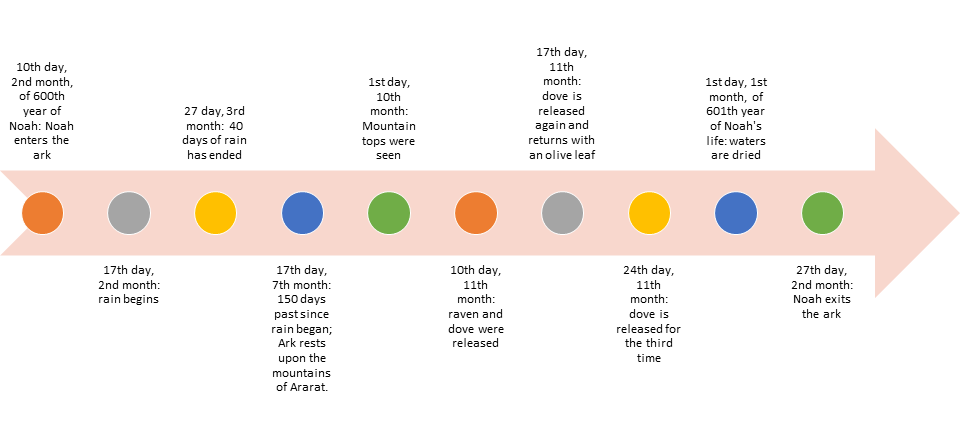
10th Day of the Second Month
(7:1-4) YHWH calls Noah and his family into the ark and sees Noah as righteous. Noah is to bring into the ark seven pairs of clean beast and fowl, and one pair of unclean beast and fowl. YHWH tells Noah that it will rain for forty days and forty nights, and all life will be destroyed from the earth.
(7:5-9) Noah obeys what God has commanded. Noah was 600 years old when the flood came, and he and his family and the creatures, male and female, enter the ark. They enter the ark on the 10th day of the second month.

E - Flood Begins (7:10–7:16)
17th Day of the Second Month
(7:10-11) A week later, the fountains of the deep are broken and the windows of heaven are opened on the 17th day of the second month.
40 Days and Nights
(7:12-16) Rain is upon the earth for 40 days and nights. After Noah’s family and the creatures have entered the ark, YHWH closes the vessel for Noah.
Lunar Month and Solar Year
What is interesting are the months and days in this Toledoth. In those times, the number of days in a lunar month was 30 days, and the number of days in a solar year was 360 days. However after the flood, a lunar month became slightly shorter, and the solar year became five days longer.
F - Waters Rise (7:17–7:24)
17th Day of the Seventh Month
(7:17-24) The flood is upon the earth for forty days. The waters prevail and the whole earth is covered. Fifteen cubits above the mountains the waters do prevail, which is 25.5 feet higher above the mountains. All mankind and creatures outside the ark are destroyed. The waters prevail for 150 days, which is five months.
High Mountains
I doubt that the mountains were as high as Mt. Everest at that time of the flood. The Himalayas developed as the earth was changing after the flood.
G - Ararat (8:1–8:5)
17th Day of the Seventh Month
(8:1-4) And God remembers Noah and the creatures, and causes a wind to pass over the earth and to restrain the waters. Thus, the waters start to abate 150 days after rising. The ark comes to rest on the 17th day of the seventh month upon the mountains of Ararat.
1st Day of the Tenth Month
(8:5) As the waters continue to recede, the tops of the mountains can be seen on the 1st day of the tenth month.
F' - Waters Recede (8:6–8:12)
10th Day of the Eleventh Month
(8:6-9) After 40 days, which would have been on the 10th day of the 11th month, Noah sends forth a raven and a dove, but the dove returns to the ark.
Biblically, a raven is an unclean bird, but a dove is a clean bird.
17th Day of the Eleventh Month
(8:10-11) Seven days later, on the 17th day of the eleventh month, Noah releases the dove for a second time, and she returns with an olive leaf.
24th Day of the Eleventh Month
(8:12) Another seven days, on the 24th day of the same month, Noah sends forth the dove, which does not return again. Interestingly, the dove was released three times.
E' - Earth Dried (8:13)
1st Day of the First Month
(8:13) On the 1st day of the first month in the 601st year, Noah removed the covering of the ark and saw the ground was dry. However, Noah was waiting on God’s timing.
D' - Exiting the Ark (8:14–8:19)
27th Day of the Second Month
(8:14-19) God calls Noah and his family out of the ark along with all the creatures so that they may breed abundantly, be fruitful, and multiply upon the earth.
C' - God's Covenant with Noah (8:20–9:7)
God's Covenant With Noah
(8:20-21) Noah builds an altar unto YHWH, and offers every clean beast and fowl as olot (burnt offerings) upon it. After YHWH smells a sweet odor, He says he will not curse the ground for man’s sake or living thing, because the imagination of man’s heart is evil from his youth.
(9:1–7) God blesses Noah and his sons, and commands them to be fruitful, to multiply, and to fill the earth. They are allowed to eat animal life, like the green herb, but they are not allowed to eat blood. God will require the blood of every man who is murdered by beast or man. Returning to the second half of the poetry, the reason against murder is that man is made in the image of God. This passage ends for mankind to be fruitful and multiply, and to bring forth abundantly and multiply.
The environment of the earth has changed, and animal protein would now be important for healthy bodies.
POETRY THEME
(8:22, 9:6)
While the earth remains, seedtime and harvest, and cold and heat, and summer and winter, and day and night, shall not cease.
Whoso sheds the blood of man, by man shall his blood be shed: For in the image of God, He made man (adam).
B' - Earth Not To Be Destroyed By Flood (9:8–9:17)
God Establishes a Covenant
(9:8-11) In His first speech to Noah and his sons, God establishes a covenant with Noah and his descendants and to all the creatures, that they would never be cut off by a worldwide flood, nor should the earth be destroyed by a worldwide flood.
God Gives the Token of the Covenant
(9:12-17) In His second speech, God gives the token of the covenant which He makes between Himself and mankind and every creature. This token is the bow in the cloud. The importance of the bow in the cloud as the sign of the covenant is repeated here.
A' - Noah's Three Sons (9:18–9:29)
Noah's Sons
(9:18-19) The sons of Noah that left the ark were Shem, Ham, and Japheth.
A Tragic Event
(9:20-24) Noah begins to be a husbandman, and plants a vineyard. Now grapevines don’t produce until the third year. So, the following event took place a few years later after the flood. Noah enjoyed the wine, and was drunk and uncovered within his tent. Ham saw the nakedness of his father, and told his brothers. Shem and Japheth went in backwards and covered the nakedness of their father. When Noah awoke from his wine, he knew what his younger son, Ham, had done to him.
While some think that Ham performed an indecent act upon his father, the Hebrew wording suggests that Ham uncovered the nakedness of his father by taking advantage of his mother, who would have become pregnant with Canaan.
Poetry Theme
(9:25-26) Noah curses Canaan. Ham, being the father of Canaan, does not mean that Canaan was born yet.
And he says,
Cursed be Canaan;
servant of servants he is unto his brethren.
And he says,
Blessed of YHWH my God is Shem;
and Canaan is servant to him.
Noah’s Benedictory Statement.
(27) Noah’s Benedictory Statement.
God does give beauty to Japheth,
And he dwells in tents of Shem,
And Canaan is servant to him.
Noah’s Toledoth Epilogue
(9:28-29) Noah is 600 years old at the time of the flood, and lives 350 years more after the flood. Therefore, he is 950 years old when he dies.
THE TOLEDOTH OF NOAH's SONS
A - Prologue (10:1)
(10:1) Prologue: Noah’s sons are Shem, Ham, and Japheth. They each have descendants.
a - Descendants of Japheth (10:2–10:5)
(10:2-4) Japheth has 7 sons, including Gomer who has 3 sons, and Javan who has 4 sons.
(10:5) Epilogue: These descendants of Japheth are the Gentiles.
b - Descendants of Ham (10:6–10:20)
Ham's Descendants
(10:6) Ham has 4 sons, who each have descendants.
(10:7-8) Cush has 5 sons, including Raamah, who has 2 sons.
(10:13-14) Mizraim, the son of Ham, has seven sons. The Philistim come from Casluhim.
(10:15-19) Canaan has Sidon and Heth. From them came the families of the Jebusi, the Amori, the Girgashi, the Hivi, the Arki, the Sini, the Arvadi, the Zemari, and the Hamathi. These families spread abroad. The border of the Canaanites was Sidon (in Lebanon) toward Gerar unto Gaza, toward Sodom, Gomorrah, Admah, Zeboim, and Lasha.
(10:20) Epilogue: These sons are the descendants of Ham.
Who Was Nimrod?
(10:9-12) Nimrod, aka Sargon (c. 2234-2234 BC) was a descendant of Cush centuries later, and who was a powerful one. He lived about 500 years after the Tower of Babel, and would have been a contemporary of Abram’s grandfather, Nahor. Nimrod means “to rebel”. He united the people against YHWH.
Both Sargon and Nimrod[1]:
1) may be associated with the geographical origin of Sargon’s Kish and Nimrod’s Cush.
2) brought Akkad into importance;
3) were involved in initial building projects in Assyria;
4) had a lasting influence related to Assyria;
5) were legendary for their military exploits and brutality.
c - Descendants of Shem (10:21–10:31)
(10:21-22) Shem has 5 sons, who each have descendants. One of his sons, Aram, has 4 sons.
(10:23) Aram has 4 sons.
(10:24-31) Another of Shem’s son is Arphaxad, who had Salah, who then had Eber. Eber has two sons Peleg and Joktan. The Jews are descended from Peleg; however, Joktan has thirteen sons.
The name Peleg means to divide. What does it mean the earth was divided? Could the earth have been one big continent, Pangea, and began to separate into several continents? Could there have been geological upheavals? Was this at the same time when the language was divided and mankind was scattered?
(10:31) Epilogue: These sons are the descendants of Shem.
B - Epilogue (10:32)
(10:32) These genealogies are the families of Noah.
C - Scattered (11:1–11:9)
(11:1-8) Everyone speaks one language. As they journey from the east, that is the mountains of Ararat, they find the fertile land of Shinar and dwell there. They build a city and a tower. The people were convinced that they should build a city and tower, whose tower is in the heavens, and make a name for themselves lest they be scattered. YHWH visits the city and the tower. He confounds their language and scatters them abroad.
(11:9) The city was named Babel because YHWH did confound the language and scattered the people.
WHERE IS THE TOWER OF BABEL?
Plain of Shinar in Southern Mesopotamia
Eridu, also known as Babylon, is one of the best candidate for the city of Babel during the Ubaid or Uruk periods. Eridu was the chief city of Enki, the hero god of the deluge. Temple I at Eridu was completed and suddenly abandoned during the Uruk Period. Nebuchadnezzar’s Babylon does not present material evidence in these two periods, but was a developing town in the Jemdet Nasr period.
Plain of Shinar in Eastern Turkey
The plain of Shinar is in Eastern Turkey, between the rivers of the Euphrates and Tigris. Could this tower be Gobekli Tepe, near the town of SanliURfa in Eastern Turkey, and is deemed to be the oldest religious site in the world. One of the interesting facts of Gobekli Tepe is that the site was covered in haste.
DATING PERIODS
Petrovich Dating Period
Dr. Douglas Petrovich dates the Ubaid, the Uruk, and the Jemdet Nasr periods (in green) of Mesopotamia different from conventional dating. This gives us a possible date for Babel, and we can place Sargon during the life of Nahor.

Stripling Archaeological Ages
Dr. Scott Stripling dates the Archaeological Ages (in blue) different from conventional dating[1] Understanding the archaeological ages in the context of the Patriarch is useful in understanding the Scriptures better. The Neolithic Age is the New Stone Age, the Chalcolithic Age is when metalworking technology using copper became standard, and the Bronze Ages is when tin was introduced with the copper to make a stronger metal.
[1] Stripling, Scott, 2017. The Trowel and the Truth, Ramona, CA: Vision Publishing, 2017.

THE TOLEDOTH OF SHEM
A - Ten Generations (11:10–11:26)
There are several reasons that the Greek Septuagint is preferred over the Hebrew Masoretic Text for dating:
1) Luke 3:34-36 agrees with the Greek Septuagint.
2) Besides evidence from Jewish writers such as Demetrius and Polyhistor, the Book of Jubilee include Cainan.
3) In the Hebrew Masoretic Text, from Shem to Terah is about 390 years, not giving enough time to populate the earth and to include the Tower of Babel.
4) In the Greek Septuagint, from Shem to Terah is about 1270 years, giving time to populate the earth and to include the Tower of Babel.
1st Generation: Shem (11:10–11:11)
(10-11) Shem is a 100 years old when he begat Arphaxad, two years after the flood, lives another 500 years, and dies when he is 600 years old. Thus, Shem would have been born when Noah was 502 years old.
2nd Generation: Arphaxad (11:12–11:13)
(12-13) Arphaxad is 135 years old when he begets Salah, lives another 400 years, and dies when he is 535 years old.
3rd Generation: Cainan (11:13)
(13) Cainan is 130 years old when he begets Salah, lives another 330 years, and dies when he is 460 years old.
4th Generation: Salah (11:14–11:15)
(14-15) Salah is 130 years old when he begets Eber, lives another 330 years, and dies when he is 460 years old.
5th Generation: Eber (11:16–11:17)
(16-17) Eber is 134 years old when he begets Peleg, lives another 270 years, and dies when he is 404 years old.
6th Generation: Peleg (11:18–11:19)
(18-19) Peleg is 130 years old when he begets Reu, lives another 209 years, and dies when he is 339 years old.
Notice the lifespan had been further reduced at the timing of the earth being divided.
7th Generation: Reu (11:20–11:21)
(20-21) Reu is 132 years old when he begets Serug, lives another 207 years, and dies when he is 339 years old.
8th Generation: Serug (11:22–11:23)
(22-23) Serug is 130 years old when he begets Nahor, lives another 200 years, and dies when he is 330 years old.
9th Generation: Nahor (11:24–11:25)
(24-25) Nahor is 179 years old when he begets Terah, lives another 125 years, and dies when he is 304 years old.
10th Generation: Terah (11:26)
(26) Terah is 70 years old when he begets Abram, Nahor, and Haran, and dies when he is 205 years old (11:32).