Division II
(Matthew 8:1 – 11:1)

8:1-9:36 Narrative: Authority and Healing Miracles
8:1-4 The Leper Is Cleansed
Leprosy

Leprosy, Mycobacterium leprae, is an infectious disease originating in Eastern Africa. The disease affects the skin, the peripheral nerves, the upper respiratory tract, and the eyes.
The Tomb of the Shroud,* located in the lower Hinnom Valley next to the tomb of Annas, reveals the earliest proven case of leprosy. He was thought to be a priest or at least he was affluent, and the DNA of leprosy and tuberculosis was found in his bones. On account of his leprosy, he was not given a second burial, in which his bones would have been transferred to an ossuary (bone box).
* https://www.sciencedaily.com/releases/2009/12/091216103558.htm
Central Theme: Cleansed
Jesus cleansing of the leper is the central theme of this passage. Notice that Jesus stretched out his hand and touched this unclean leper.
Show Thyself to the Priest
The man was to offer a sacrifice of a clean living bird. Next, another clean, living bird was dipped into the blood of the sacrificed bird along with cedar wood, scarlet yarn, and hyssop; and then the man was sprinkled seven times before the release of the living bird. The man would have to cleanse his clothes, shave off all his hair, and cleanse himself in water. Then stay within the camp but outside his tent for seven days.
On the seventh day he would shave off all his hair and cleanse himself in water. On the eighth day he would go to the priest and offer a trespass offering, a sin offering, a wave offering, and a burnt offering to God at the Tabernacle.
The cedar wood represents the cross, the scarlet yarn represents the blood of the Messiah, and the hyssop represents the transferring of the blood of the sacrifice to the sinner.
Scripture Reading - BPV
Mt. 8:1-4
1 Whereas, of Him having descended from the Mount, great multitudes followed Him.
2 And behold, a leper having come was worshipping Him, saying, Lord, if Thou are willing, Thou are able to cleanse me.
3 And having stretched out the hand, Jesus
touched him, saying, “I am willing, be thou
cleansed.” And straightway his leprosy was
cleansed.
4 And Jesus says to him, “See, thou may tell none; but
withdraw, show thyself to the priest, and offer the gift that Moses commanded, for a testimony to them.”[1]
[1] Leviticus 14:1-32
Capernaum
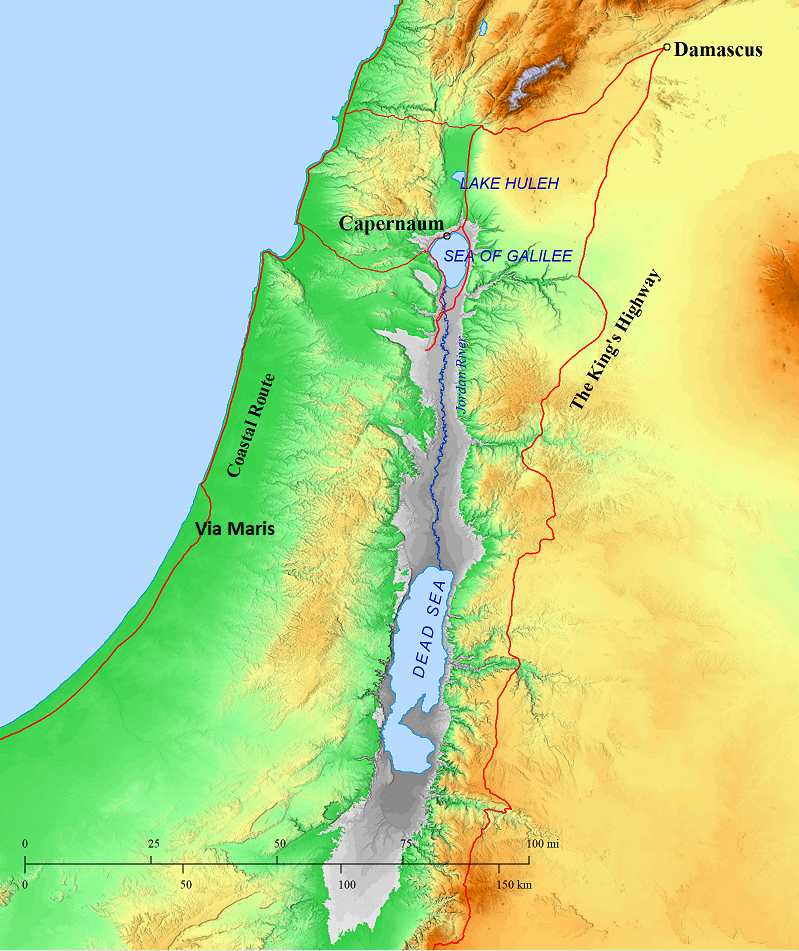
Capernaum is situated near or on the Via Maris route from Egypt to Damascus, and was an important town. Kfar Nahum means Nahum’s village in Hebrew, and was located on the border of the tribes of Zebulun near Naphtali. The Greek is Capernaum.
A Centurion

Centurion
A centurion was a Roman officer in command of 80-100 infantrymen. Although Herod Antipas might have had his own legion patterned after the Roman military, the Roman presence of the Legio VI Ferrata insured order in the Roman client state of Syria and Israel. Besides, the centurion was aware of the cultural differences of Jews and Gentiles as well as his own unworthiness.
A Young Servant
The Greek word παῖς= pais is used here, and can mean male or female child or a servant. Could the servant have been a young servant?
Authority
The centurion knew that Jews would not enter a Gentile home. However, the centurion understood about faith and authority, and had faith that Jesus held the authority to heal.
Central Theme: Faith
Great faith was not found in Israel, until Jesus met this Roman centurion. The Greek word, θαυμάζω=thaumazō for marveled, is a very strong word used here!
Recline
To recline is to eat in a reclining position rather than sitting upright in a chair.
Kingdom of the Heavens
Jesus shockingly informs the crowd that in whom one’s faith is based, will determine entrance into the Kingdom of Heaven, and not by descent from the three great patriarchs: Abraham, Isaac, and Jacob.
Did Faith
As the centurion had faith, his young servant was healed. Notice that his young servant was not immediately healed, but within that hour.
Although archaic, the word faith can be a verb.
Scripture Reading - BPV
Mt. 8:5-13
5 Whereas, of Jesus having come into Capernaum, a centurion came to Him, calling upon Him,
6 and saying, ‘Lord, my young servant has been laid in the house, a paralytic terribly tormented.’
7 And Jesus says to him, “I having come, shall I heal him?”
8 And the centurion answering, declared, ‘Lord, I am inadequate that Thou should enter in under my roof; but only speak a word and my young servant shall be healed.
9 For I also, I am a man under authority, having under myself soldiers; and I say to this one, Go, and he goes; and to another, Come, and he comes; and to my bondman, Do this, and he does it.’
10 But Jesus having heard, marveled, and said to those following, “Amen, I say to you, not even in Israel did I find so great a faith.
11 “But I say to you that many from east and shall be present, and shall recline with Abraham and Isaac and Jacob in the Kingdom of the Heavens;[2]
12 but the sons of the kingdom shall be cast out into
the outer darkness, there shall be the weeping and the gnashing of the teeth.”
13 And Jesus said to the centurion, ‘Withdraw, and as thou did faith, be it to thee.’
and his young servant was healed in that hour.
[2] Psalms 107:3
8:14-17 Peter's Mother-in-Law Touched
Peter's House
Peter’s house can be seen in Capernaum at St. Peter’s Church.

Peter's Wife
Peter’s wife, who was crucified in Rome, is mentioned by Clement of Alexandria:
“So we are told that the blessed Peter, when he beheld his wife on her way to execution, rejoiced on account of her call and her homeward journey, and addressed her by name with words of exhortation and good cheer, bidding her ‘remember the Lord.’ .”
https://archive.org/details/clementalexandr01hortgoog/page/n230
Central Theme: Left Her
When Jesus touched the hand of Peter’s mother-in-law, her fever left. Thus, she was able to minister to them.
Scripture Reading - BPV
Mt. 8:14-17
14 And Jesus having come into the house of Peter, saw his mother-in-law having been laid and fevering.
15 And He touched her hand and the fever left her; and she arose and was ministering to them.
16 And of evening having become, they brought to Him many being possessed by demons, and he cast out the spirits with a word, and he healed all those having illness.
17 so that it might be fulfilled which was poured out through Isaiah the prophet, saying, ‘Himself took our weaknesses, and He bore our diseases.[3]
[3] Isaiah 53:4
8:18-22 The Price of Following Jesus
Depart From
What does the Greek word, ἀπέρχομαι=aperchomai which translates as to depart from or to go away, have to do with Jesus, the scribe, and a disciple? This word links the parts of the passage together.
Other Side
The words, other side, refers to the other side of the Sea of Galilee; and is an introduction to where Jesus is departing.
Parallism
Compared in verses 19 and 21, is the scribe, who desires a comfortable journey, and an early disciple, who desires to obtain his inheritance.
However, in verses 20 and 22, Jesus compares fox dens and bird nests with a burial tomb for the dead.
Foxes
There are four species of foxes in Israel: the Blandford’s fox, the Fennec fox, the Rüppell’s fox, and the Red Fox shown below.

Fox Dens
Fox dens are foxholes.

Scripture Reading - BPV
Mt. 8:18-22
18 Whereas, Jesus having seen great multitudes about him, ordered to depart from to the other side.
19 And one scribe having come to Him, said to Him, “Teacher, I will follow thee wherever thou may depart from.”
20 And Jesus says to him, “The foxes have dens,
and the birds of the sky nests; but the Son of Man has not where He may lie the head.”
21 And another of his disciples said to Him, “Lord, permit me first to depart from and to bury my father.”
22 But Jesus says to him, “Follow me, and
leave lone the dead to bury their own dead.”
8:23-27 Jesus Calms the Winds and the Sea
31 AD Earthquake
An earthquake caused the storm, while Jesus is peacefully sleeping. Wind gusts can stir up a turbulent storm on the Sea, but Matthew uses the Greek word, σεισμός=seismos, meaning earthquake. We have borrowed the same word in English for seismic or seismograph.
At Ein Gedi, geologists have found evidence of two earthquakes, the first minor one being in 31 AD. This quake would have travelled up the Jordan Rift Valley all the way to the Sea of Galilee, so the boat was covered with waves called seiche (saysh), which is an oscillation of the surface of a landlocked body of water. However, Jesus was sleeping, and the disciples were highly concerned with their safety.
After rousing Him, he censored the winds and the sea. This was no small miracle.

Parallel Verses A
While verses 23-24, show that Jesus was sleeping, yet in verse 26, His disciples reaction was of fear. After commanding the winds and the sea, He brought a great calm.
Parallel Verses B
In verse 25, his disciples cry out that they are perishing; however; in verse 27 they marvel that the elements of nature, the winds and the sea, obey Him.
Scripture Reading - BPV
Mt. 8:23-27
23 And He having embarked into the boat, his disciples followed Him.
24 And behold, a great earthquake came to pass in the sea, so as the boat was being covered by the waves; but He was sleeping.
25 And his disciples having come to Him, roused Him, saying, “Lord, Save us, we are perishing!”
26 And He says to them, “What are ye afraid of,
O ye of little faith?” Then having arisen, He censured the winds and the sea, and there was a great calm.
27 But the men marveled, saying, “What kind is this one, that even the winds and the sea yield to Him?”
8:28-34 Demons Cast Into the Herd of Pigs
Country of the Gergesenes

The country of the Gergesenes refers to the area near the city of Gergesa (Kursi), which was in the territory of the Gadarenes.
One can see the Sea of Galilee from ancient Gadara, located near Umm Qais in modern Jordan.
While the Textus Receptus uses the term Gergesenes, some older codexes use the term Gadarenes. Both are correct, but the term Gergesenes is more precise. Matthew would have known the geography of the area.
Central Theme: Cast Out
Jesus cast the demons out of the two who were possessed by demons into the herd of pigs.
Pigs are considered unclean by Jewish standards. The cities of the Decapolis were a mixed culture of Jews and Gentiles, and so raising pigs was a tolerable occupation.
Location of the Tombs and Steep Bank
This steep bank and the tombs are the only possible location on the eastern side of the Sea of Galilee.


Scripture Reading - BPV
Mt. 8:28-34
28 And of Him having come to the other side, to the country of the Gergesenes, two being possessed by demons met Him, coming forth out of the tombs, very dangerous, so as to prevail over any one not to pass through that way.
29 And behold, they cried aloud, saying, “What to us and to Thee, Jesus, Son of God? Did Thou come here before the proper time to torture us?”
30 But there was far from them a herd of many pigs feeding.
31 And the demons were calling on Him, saying, “If Thou cast us out, allow us to depart from into the herd of the pigs.”
32 And He said to them, “Withdraw!” And having come forth they departed from into the herd of the pigs, and behold, the whole herd of the pigs rushed headlong down the steep bank into the sea, and died in the waters.
33 But those feeding did flee, and having come forth into the city, they reported all, and everything of those being possessed by demons.
34 And behold, all the city came out to a meeting with Jesus. And having seen Him, they called on him that He would pass over from their borders.
9:1-8 A Paralytic Forgiven
His Own City
His own city is Capernaum.

Parallelism
Verses 2 and 4-6 compare forgiving sins.
Verses 3 and 8 compare the reaction of the scribes with the reaction of the crowds.
Send Away Sins
The Greek word ἀφίημι=aphiēmi means to send away, but can be translated to forgive. The word, forgive, is an Old English word meaning to give up resentment of or grant relief.
Jesus has the authority to send away or forgive sins.
Scripture Reading - BPV
Mt. 9:1-8
1 Having embarked into the boat, He went across and came to his own city.
2 And behold, they were bringing to Him a paralytic having been laid upon a bed. And Jesus having seen their faith, said to the paralytic, “Cheer up, child,
your sins are sent away from thee.”
3 And behold, some of the scribes said in themselves, “This one blasphemes!”
4 And Jesus having known their considerations, said, “To what end do ye consider evil in your hearts?
5 “For which is easier to say, Thy sins are
sent away, or to say, Arise and walk.
6 “But that ye may know that the Son of Man
has authority upon the earth to send away sins;” then He says to the paralytic, “Having arisen, take up
thy bed, and withdraw to thy house.”
7 And having arisen, he came forth to his house.
8 But the multitudes having seen, marveled and magnified God, who having given authority such as this to men.
9:9-13 Matthew Is Called

Customhouse
A customhouse is a building at strategic places, where a custom tax is imposed on imports and exports. Capernaum would have been such a place to have a customhouse, being located beside the Sea of Galilee and along the route of the Via Maris.
Publicans
Publican is a collector of tolls, customs, or taxes.
Reclining Together at Table
The custom is to recline or lie down while eating.
Scripture Reading - BPV
Mt. 9:9-13
9 And Jesus passing by from there, saw a man sitting at the customhouse, called Matthew. And He says to him, “Follow me.” And having risen, he followed Him.
10 And it came to pass of his being laid up in the house, and behold, many publicans and sinners, having come, were reclining together at table with Jesus and his disciples.
11 And the Pharisees having seen, were saying to his disciples, “Wherefore does the Your teacher eat with the publicans and sinners?”
12 But Jesus having heard, said to them, ‘They who are
strong have no need of a physician, but they who are ill.
13 ‘And having gone, learn ye what it is, ‘I will mercy,
and not sacrifice.’[4] For I came not to call righteous
ones, but sinners into repentance.”
[4] Hosea 6:6
9:14-17 Old and New
Parallism
Verses 15, 16 and 17a compare the difficulty of trying to patch up old ways.
Bridegroom
The bridegroom is Jesus.
Uncarded
Uncarded is unwashed, or unshrunk cloth.
New Wine
New wine represents the new life separate from legalism or asceticism.

Scripture Reading - BPV
Mt. 9:14-17
14 Then the disciples of John come to Him, saying, “Wherefore do we and the Pharisees fast much; but Thy disciples fast not.”
15 And Jesus said to them, “Cannot the sons of the
bridechamber mourn as long as the bridegroom is with them? But days shall come whenever the bridegroom may be taken away from them, and then they shall fast.
16 “But no one lays on a patch of an uncarded strip
of cloth on an old cloak; for its piece inserted to fill up removes from the cloak, and becomes a worse rent.
17 “Nor do they put fresh wine into old wineskins;
but if not the wineskins burst, and the wine is poured out, and the wineskins are destroyed. But they put new wine into new wineskins, and both are preserved together.”
9:18-26 A Daughter Risen and a Woman Saved
Central Theme: Salvation
Separating the story of Jesus healing the ruler’s daughter is the story of a woman with a discharge who desired to be saved. Why?
Most translations use the word healed, but the Greek word σώζω=sōzō to save is used. Why does she want to be saved?
First, having a discharge would make her unclean. Second, she had had this blood discharge for 12 years.
She represents Israel, who is unclean. The twelve years represent the twelve tribes. Israel is in dire need of the salvation of the Lord.
Discharge
αἱμοῤῥέω=aihmorrheō means hemorrhage, a menstrual disorder.
Having a discharge would make her unclean.
Tzitzit of His Cloak

Flute-players
Flute players and wailing women are hired as professional mourners.
Scripture Reading - BPV
Mt. 9:18-26
18 Of Him saying these things to them, behold, a ruler having come, was prostrating himself to Him, saying that, “My daughter just now died, but having come, place Thy hand upon her, and she shall live.”
19 And Jesus having risen, followed him, also his disciples.
20 And behold, a woman having a discharge of blood twelve years, having come behind to Him, touched the tzitzit of his cloak,
21 for she was saying within herself, “If only I may touch his cloak, I shall be saved.”
22 But Jesus having turned around and having seen her, said, “Cheer up, daughter, thy faith has saved thee,” and the woman was saved from that hour.
23And Jesus having come into the house of the ruler, and having seen the flute-players and the multitude making an uproar,
24 He says to them, “Withdraw, for the maiden did
not die, but sleeps,” and they were laughing scornfully at Him.
25 But when the multitude was cast out, having entered, He laid hold of her hand, and the maiden arose,
26 and the fame to this went out into all that land.
9:27-34 Blind Men and a Mute Man
Show Mercy
Showing mercy would be a cry for help. Notice the reference to Jesus being the Son of David.
The Blind Men
Notice that Jesus ignored their request as He passed by, until they came to the house. Faith, an action here, must be confessed.
See Ye
Obviously, local people would know about the healing. However, these two men went other places to spread the news of their healing.
Mute
In this case, the cause of being mute is not a physical defect, but is due to demon possession.
Scripture Reading - BPV
Mt. 9:27-34
27 And Jesus passing by from there, two blind men followed Him, crying aloud and saying, “Show mercy upon us, Son of David.”
28 But He having come to the house, the blind men came to Him, and Jesus says to them, “Do ye faith
that I am able to do this?” They say to him, “Yes, Lord.”
29 Then He touched their eyes, saying, “According
to your faith be it to you,”
30 And their eyes were opened, and Jesus urgently admonished them, saying, “See ye, no one knows;”
31 but having gone forth, they spread abroad about Him in all that land.
32 But as they are going out, behold, they brought to him a mute man, a possessed by a demon,
33 and the demon having been cast out, the mute talked, and the multitudes marveled, saying that, “Never was it seen in Israel:”
34 But the Pharisees were saying, “By the ruler of the demons he casts out the demons.”
9:35-38 Sheep and the Harvest
Central Theme: Compassion
Jesus has compassion on the multitudes because of their spiritual condition.
Scripture Reading - BPV
Mt. 9:35-38
35 And Jesus was going around all the cities and the villages, teaching in their synagogues, and proclaiming the good news of the kingdom, and healing every disease and every weakness among the people.
36 But having seen the multitudes, He felt compassion for them, because they were faint and have been cast out, just as if sheep not having a shepherd.[5]
37 Then He says to his disciples, “The harvest indeed
is much, but the husbandmen few;
38 “Ask ye therefore the Lord of the harvest, that he
may cast forth husbandmen to His harvest.”
[5] Ezekiel 34:2-6
10:1-11:1 Teaching: Apostolic Instruction
10:1-4 The Twelve Apostles
The Twelve
1) Simon Peter
2) Andrew, brother of Peter
3) James of Zebedee
4) John of Zebedee
5) Philip from Bethsaida
6) Bartholomew or Nathanael
7) Thomas Didymus
8) Matthew, the tax-gatherer, of Alphaeus
9) James of Alphaeus (the Less or Just)
10) Lebbaeus Thaddaeus, Judas (Barsabbas) of James
11) Simon the Canaanite, called Zelotes
12) Judas Iscariot, who delived up Jesus, of Simon
Twelve Disciples
The twelve disciples represent the twelve tribes of Israel. At this point, the twelve had already been selected, but now Jesus was commissioning them as apostles for healing ministry.
What is an Apostle
ἀπόστολος=apostolos is a messenger or ambassador.
Notice that Simon Peter is the leader of the group.
Scripture Reading - BPV
Mt. 10:1-4
1 And having called to Him his twelve disciples, he gave to them authority over unclean spirits, so as to cast them out, and to heal every disease, and every weakness.
2 And of the twelve apostles the names are these: first, Simon, who is called Peter, and Andrew his brother; James of Zebedee, and John his brother;
3 Philip, and Bartholomew; Thomas, and Matthew the tax-gatherer; James of Alphaeus, and Lebbaeus who was was called by the surname Thaddaeus;
4 Simon the Canaanite, and Judas Iscariot, who also having delivered up Him.
10:5-15 The Ministry of the Apostles
Lost Sheep
The training ground for these new apostles is the lost sheep of Israel, not in Samaria or in other nations.

Proclaim Ye
Besides proclaiming the Kingdom of the Heavens, they were to heal the sick, cleanse the lepers, raise the dead, and cast out demons.
Central Theme: Provision
Instead of providing for their own welfare, the apostles were to allow God to provide for them.
It’s not that they couldn’t wear a tunic or sandals, or carry a rod, but they are being told not to bring extra.
Scrip
What is a scrip? A pouch or wallet.
Worthy
Hospitality is a common characteristic of Middle Eastern culture. Finding someone worthy should be relatively easy.
Peace
Peace is not just a greeting, but a blessing to the worthy receiver.
Dust
κονιορτός=koniortos means dust stirred up or a cloud of dust.
Sodom and Gomorrah
Sodom and Gomorrah were two cities, noted for their inhospitality, which were destroyed in the days of Abraham.

Scripture Reading - BPV
Mt. 10:5-15
5 Jesus sent away these twelve, having given orders to them, saying, “Ye must not depart from into the way
of the nations, and ye must not enter into a city of the Samaritans,
6 “but be ye going rather to the sheep having been lost
of the house of Israel.[6]
7 “But going on, proclaim ye saying that, the Kingdom
of the Heavens has come near;
8 “heal those being weak, cleanse the lepers, raise the
dead, cast out demons; freely ye did receive, freely ye give.”
9 “Procure ye not gold, nor silver, nor copper in your girdles,
10 “nor scrip for the way, nor two tunics, nor sandals, nor rod: for worthy is the husbandman of his nourishment.”
11 “But into whatever city or village ye should enter, inquire who in it is worthy, and there abide, till ye should go forth.
12 “And entering into the house greet her,
13 “and if indeed the house be worthy, may your peace
come upon her; but if it may not be worthy, let your peace turn around to you.
14 “And whoever should not greet you with the right
hand nor should hear your word, going out of that house or city, shake off the dust of your feet, 15 “Amen, I say to you, It shall be more bearable for the land of Sodom and Gomorrah in the day of judgment than for that city.”
[6] Isaiah 53:6.
10:16-25 In Persecution
Central Theme: What to Say
Instead of being anxious about what to say for a defense, the apostles were to allow God to give them the words.
Beelzebul
Beelzebul was a Canaanite god, Lord of the Flies.

Scripture Reading - BPV
Mt. 10:16-25
16 “Behold, I, send you away as sheep in the middle of wolves, therefore be ye prudent as the serpents, and guileless as the doves.
17 “But, take ye heed of men, for they will
deliver ye up to sanhedrins, and in their synagogues they will flog you,
18 “and ye will be brought before leaders, also, and
kings on account of Me, for a testimony to them and to the nations.
19 “But whenever they may deliver you up,
may ye not be anxious about how or what ye may say, for it shall be given to you in that hour what ye may say;
20 “for ye are not those speaking, but the
Spirit of your Father that is speaking in you.”[7]
21 “But brother will deliver up brother to death, and father, child; and children will rise up against parents, and will put them to death, [8]
22 “and ye will be hated by all on account of my name,
but he having abided patiently to the end, he shall be saved.
23 “But whenever they should persecute you in this
city, flee to another, for amen I say to you, no, ye should not have completed the cities of Israel till the Son of Man should come.”
24 “A disciple is not above the teacher, nor a bondman
above his master;
25 “sufficient for the disciple that he may be as his
teacher, and the servant as his master; if they called the master of the house Beelzebul, how much more those belonging of his house?”[9]
10:26-33 Better Than Sparrows
Fear of Man; Fear of God
Fear of God must override the fear of man. Although man can kill the body, God is able to destroy both soul and body in Gehenna.
Upon the House
Houses had flat roofs, on which one could proclaim the Good News.

Central Theme: Better than Sparrows
His apostles are better than the sparrows, which the Father notices. He even knows the number of hairs on one’s head.
Sparrows
Sparrows were cheap food for the poor, and they were considered a clean meat by Biblical standards (Leviticus 11).

Assarion
The assarion, or as, was a bronze or copper penny worth about 1/16 of a denarius.

Confess...Deny
Fear of God by confessing Him before men is most important. The fear of man would cause one to deny Him before men.
Scripture Reading - BPV
Mt. 10:26-33
26 “Therefore, ye should not fear them, for there is
nothing having been concealed, that shall not be revealed, and hidden that shall not be known;
27 “what I say to you in the darkness, speak in the
light, and what you hear in the ear, proclaim upon the house.
28 “And be ye not afraid of those killing the body, but
not being able to kill the soul, but fear Him rather who being able to destroy both soul and body in Gehenna.”
29 “Indeed, are not two sparrows sold for an
assarion? and not one of them shall fall to the earth without your Father;
30 “but of you, even the hairs of the head are
all numbered;
31 “therefore be not afraid, ye are better than
many sparrows.”
32 “Therefore, every one who will confess in Me
before men, I also shall confess in him before my Father who is in the Heavens;
33 “but whoever should deny Me before men, I also
shall deny him before my Father who is in the Heavens.”
10:34-39 The Sword and the Cross
Parallism
Verse 34 and verses 38-39 focus on the sword and the cross.
Verses 35-37 focus on loyalty to Christ above loyalty to the family.
Peace?
Although the mission of Christ is to bring peace, not every one will accept Him or his followers.
Sword
A μάχαιρα=machaira, or gladius, was a short sword carried by a foot soldier.

Loving
φιλέω=phileō is translated as love and means to treat affectionately. However, natural love of family should be subordinate to loving God.
Cross
This is the first mention of a cross in this gospel and the New Testament. The cross wasn’t a necklace to be worn, but a stark reality of crucifixion.
Scripture Reading - BPV
Mt. 10:34-39
34 “May ye not consider that I came to cast peace on
the earth; I did not come to cast peace, but a short sword;
35 “for I came to divide a man against his father,
and a daughter against her mother, and a
daughter-in-law against her mother-in-law, [10]
36 “and the enemies of a man are those belonging of
his house.
37 “He loving father or mother above Me, is not worthy of Me, and he loving son or daughter above Me, is not worthy of Me.”
38 “And he who does not receive his cross and follows after Me, is not worthy of Me.
39 “He having found his life shall utterly lose it, and he having utterly lost his life for my sake shall find it.”
[10] Micah 7:6
10:40-42 Rewards
Greeting with the Right Hand
Greeting with the right hand would indicate hospitality, but greeting with the left hand or no hand would indicate rudeness.
Give To Drink
Giving to drink a drinking-cup of cold water would be basic hospitality, but to do so for a dispicle would be rewarded.

Central Theme: Prophets and Righteous
However, greeting a prophet because he is a prophet or greeting a righteous man because he is a righteous man would be a greeting beyond mere hospitality.
Scripture Reading - BPV
Mt. 10:40-42
40 “He greeting you with the right hand is greeting
Me with the right hand, and he greeting Me with the right hand is greeting Him with the right hand, who having sent Me;”
41 “He greeting a prophet with the right hand in the name of a prophet, shall receive a reward of a prophet, and he greeting a righteous man with the right hand in the name of a righteous man, shall receive a reward of a righteous man;”
42 “And whoever may give to drink to one of these
little ones a drinking-cup of cold water, only in a name of a disciple, amen I say to you, no, he should not utterly lose his reward.”
11:1 Closing of the Apostolic Instruction

Parallel Closing
Although this verse serves as a closing passage, it parallels the opening of the Apostolic Instruction (see Matthew 10:1-4)
Scripture Reading - BPV
Mt. 11:1
1 And it came to pass, when Jesus completed appointing his twelve disciples, he passed over from there to teach and to proclaim in their cities.